
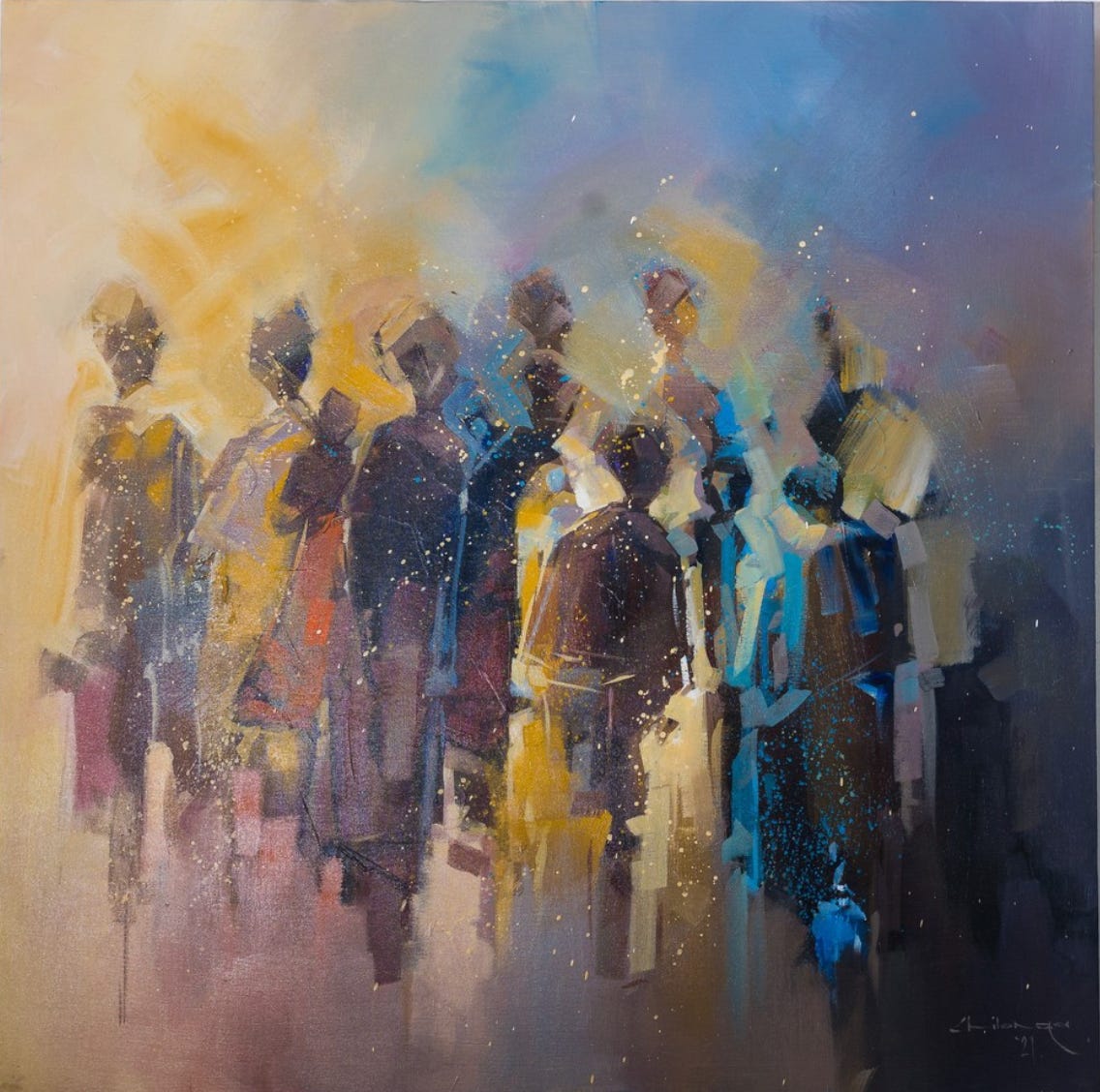
1 Haji Chilonga’s Gathering (110x110cm)
Josef Horwath - GPI Sustainable Growth Fellow
Since the Peace of Westphalia was signed in 1648, state formation has gradually become the dominant model of political organization, giving rise to the modern “Westphalian” state: a polity with defined borders and a sovereign leader who claims a monopoly on violence. As we know it, there are very few areas of the world that have no national or state governance. Yet the modern state system arrived in Africa largely through colonial conquest rather than endogenous state formation, leaving the continent with some of the youngest states in the world.
Take Tanzania for example, which recently marked 65 years of independence. The United States turned 65 in 1841 when the American Civil War was still two decades away. State formation can be slow, unpredictable, and quite messy. Too often, the present-day challenges facing African states are read as underachievement, rather than part of the long process of state formation. Yet historical research suggests that the modern nation-state was not the only path political development in Africa could have taken. The modern, centralized nation-state is an imported blueprint that ignores the highly successful, non-linear forms of governance that preceded it. Understanding this precedent not only sheds light on what the Westphalian system erased, but shows that it is unfair to judge the speed at which these countries play “catch up” to a foreign system.
A continent of small polities
New research by Henn and Robinson (2025) suggests that state formation was purposefully resisted by many African communities. They estimate that there were over 45,000 polities across the continent, with the vast majority being small and deliberately decentralized. These were societies that structured their political systems to constrain authority, preserve local culture, and make coexistence between polities peaceful and inviting. The decentralized structure of polities created a system of mutual respect and co-existence among groups.
Henn and Robinson provide an interesting linguistic example of interpersonal relationships driving polities. They find that 61% of African language groups use the same word for “guest” and “stranger,” with that number rising to 84% across Sub-Saharan Africa. When a stranger is greeted as a guest, society is built on welcome. This ethos created a political structure that was remarkably stable from within. What may appear to be a struggle to centralize may, in some cases, reflect a preference for more decentralized and communal forms of governance. These political arrangements were also shaped by geography, demography, and historical circumstances.
Eurasia tells a different story, where state formation was the dominating priority. Political structures were built to compete, clash, and consolidate power. See Charles Tilly’s line, “War made the state, and the state made war.”
When the stranger arrived
Unfortunately, there is tragic irony at the heart of having a decentralized political structure. The features that made the political system of decentralization suitable for coexistence in African communities, made it particularly vulnerable to a “stranger” who arrived not to coexist, but to disrupt. European mercantile capitalism and its predation to expand encountered a continent organized on principles entirely unprepared for state-driven violence. The separation of polities made it ever more difficult to resist colonial forces, which were statistically more violent.
Conflict data compiled by Brecke (1999), one of the only systematic global tabulations of pre-modern warfare, shows considerably lower levels of conflict in Africa than in Europe or Asia across the pre-colonial times. Europe’s record from roughly 1400 to 1700 AD across is dominated by continuous wars, religious conflicts, and imperial conquests.
Conflict not Conquest
Africa’s record looks different. When wars occurred, they rarely ended in annexation. Smith’s (1976) study of West African warfare found that territorial expansion was not the normal outcome of military victory. Conflict was influenced by trade routes and the availability of resources, often in targeted strikes rather than fully fledged wars.
Wilfahrt (2025) corroborates this, where she finds that African polities with a greater concentration of power under a monarch (centralized) were significantly more likely to see conflict relative to the baseline. This claim is reflected today, where some of Africa’s earliest states continue to be conflict prone, such as Mali and Sudan. On the other hand, polities with more indirect rule appeared less likely to experience conflict, demonstrating the effectiveness of a kinship-based decentralized system. Larger monarchies which prioritized the monopolization of territories wound up in conflicts that their goal of totality lent itself to.2 The resistance to centralization is better seen as successful political organization that preceded violent colonization.
The verdict is premature
There are objections to the principle of decentralization. Perhaps African polities were small not because they chose decentralization, but because geography and low population density made large-scale state formation impractical. Also, pre-colonial African history is under-documented and lower recorded conflict may partly reflect lower recording. Archaeological and oral evidence points to inter-communal violence that never entered Brecke’s dataset. But the underlying point remains: the political and economic structures of pre-colonial Africa were built around coherent priorities, and by their own logic, were different.
Modern African states are heirs to political traditions that are sophisticated and distinct from the European template against which they are habitually judged. The development visible today is not evidence of a civilization that “failed” to develop. It is evidence of a civilization that was interrupted and is now very young in comparison. Whether recent statehood leads to more conflict or great economic booms, only time will tell. But we can work towards the latter, with an understanding that the traditions that existed long before statehood could coexist in harmony.
References
Brecke, P. (1999). Violent Conflicts 1400 A.D. to the Present in Different Regions of the World.
Smith, R.S. (1976). Warfare and Diplomacy in Pre-Colonial West Africa. Methuen, London.
Chilonga’s artpiece was supplied by the Rangi Gallery in Dar es Salaam, Tanzania. You can visit their website here.
Further readings into centralization and African States can be found in Jeffrey Herbst's States and Power in Africa: Comparative Lessons in Authority and Control and Jean-François Bayart's The State in Africa: The Politics of the Belly (1993).
"the modern state system arrived in Africa largely through colonial conquest rather than endogenous state formation, leaving the continent with some of the youngest states in the world"
Noted. The things that existed in Africa before colonialism were not states? Were there states in America before the USA?
I suppose the state arrived China in 1949?