

1 Masoud Kibwana’s Unity (100x80cm)
Authoritarian regimes have it tough. You seize power promising stability, dignity, prosperity. The people were sick of self-serving politicians talking but not delivering. “You can't eat freedom” they cried. They need jobs, roads, electricity. Give me control, you say, and I'll get things done. No gridlock. No opposition parties slowing everything down. Just results.
But then the complaining starts. Human rights campaigners start speaking out and there are earnest handwringing articles appearing in The Guardian. Before you know it, George Clooney has taken a break from his Nespresso commercials to tour a refugee camp mysteriously full of your citizens. But what they don’t understand is that you are delivering! You are bringing jobs and growth and the path to modernity! You can’t make an omelette without breaking a few eggs, George!
Well, maybe you can. With the rise of China and before that Taiwan, South Korea, and Singapore – all under authoritarian regimes – the dictators and wannabe dictators claimed to have something to hang their hat on. The authoritarians might cede the field regarding human rights, but when considering outcomes purely in terms of economic growth, they thought they were on safer ground. However, the weight of economic research is proving otherwise.
The ballot box, not a black box
From its origins in the 1950s development economics has been arguing about the best system of government for economic growth. Fashions and fads waxed and waned but in the 2000s and 2010s a clear picture was emerging. Democracy, whilst often noisy, messy, or gridlocked, was delivering more economic growth more consistently than authoritarian regimes. A democratic turn reduced economic volatility which allowed gains to accrue steadily. Grier and Munger’s work from 2010 showed that systems which allow peaceful leadership turnover, avoid significant growth penalty that often accompanies an unplanned leadership transition. Numerous other papers found similar: the ability to remove leaders is an economic asset, not a human rights luxury. While economic growth may feel like it’s slowed by bureaucratic transitions, democracy’s sustained consistent growth outweighs the instability that ensues following the flashiness of an authoritarian “breaking a few eggs” to get things done.
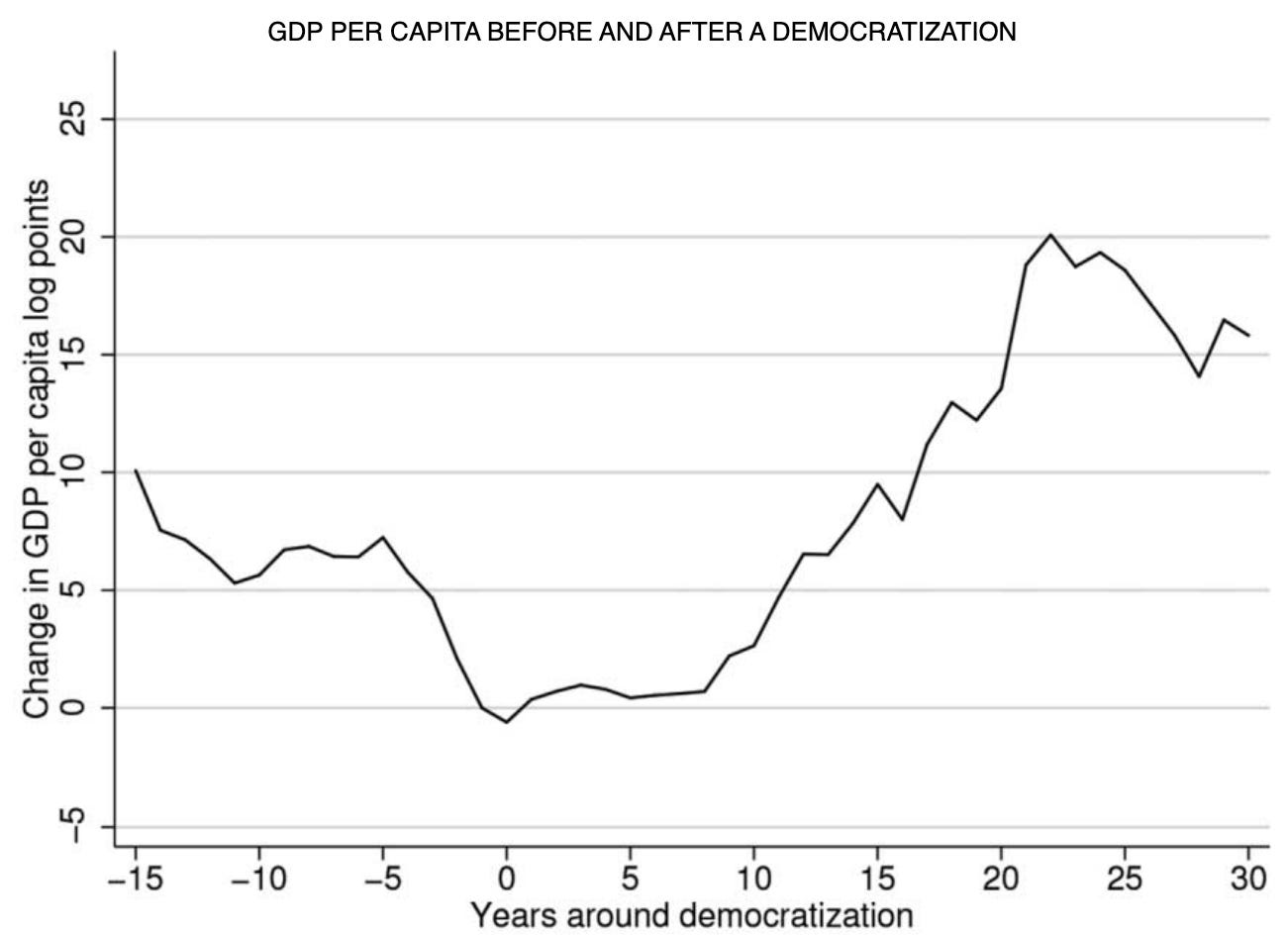
Future Nobel Laureates,2 Daron Acemoglu and James A. Robinson along with co-authors Suresh Naidu and Pascual Restrepo didn’t bury the lede with their 2019 paper Democracy Does Cause Growth. Examining the period 1960-2010, they conclude that “…a country that transitions from nondemocracy to democracy achieves about 20 percent higher GDP per capita in the next 25 years than a country that remains a nondemocracy” (see figure 1). Papaioannou and Siourounis a decade earlier found the same. Masaki and van de Walle concur and find that the longer a country remains democratic, the better the result —democracy as a procedure not a goal in and of itself. Sustained democracy increases enduring and durable factors of overall prosperity: strengthened investment, increased schooling, and improved public good provision.
The Panda in the Room
So, case closed for democracy. Except… China. For decades, China served as the authoritarian apologists’ trump card: one-party rule, no elections, limited personal freedoms, and world beating growth. The comparison with democratic India, the other Asian giant with a billion plus people, writes itself. But that is to misunderstand what democracy is – or any system of government, for that matter. Democracy is not a guarantee of riches just as authoritarianism is not a guarantee of economic turmoil. A system of government is about how policies and decisions are made. The lessons from the papers mentioned above is that democracies, on average, made more decisions that led to growth and were more often able to adjust course when things were going wrong. But authoritarian regimes can and do get things right too.
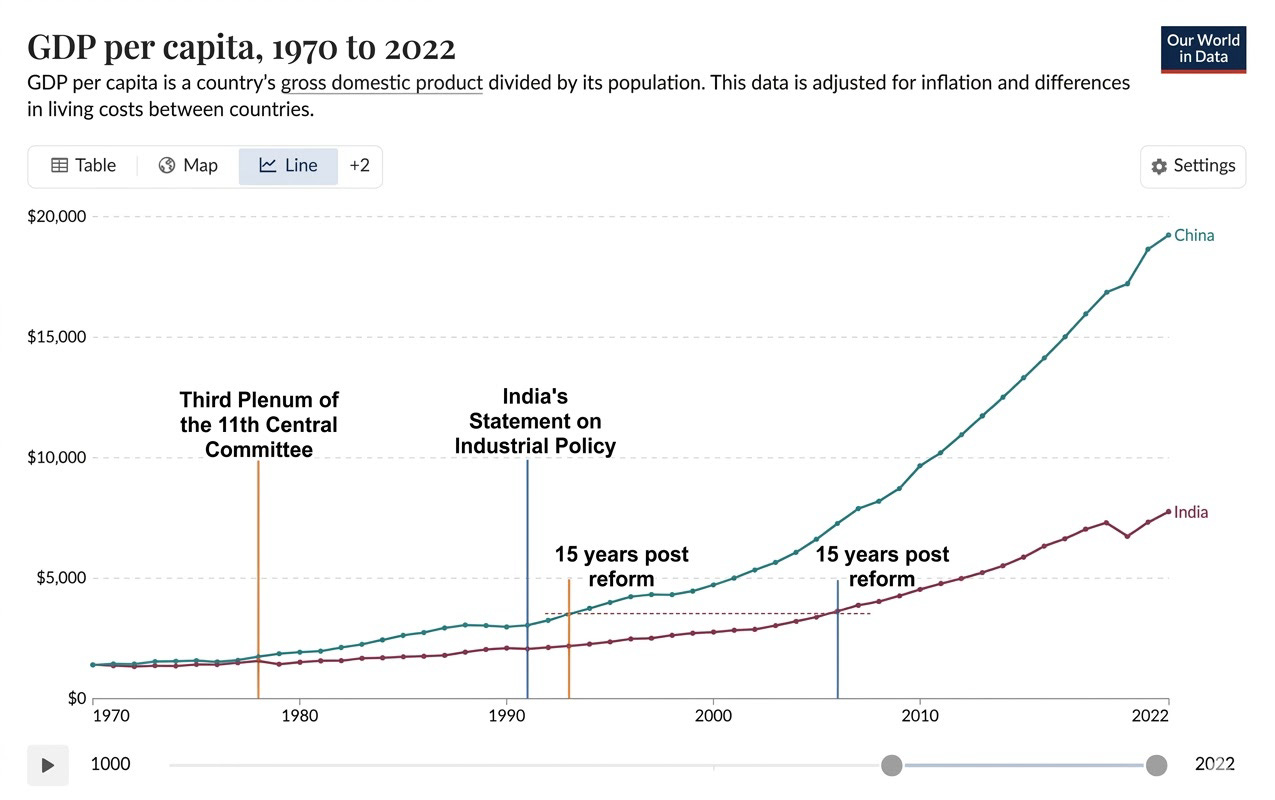
And so, in 1978, just two years after Mao Zedong’s death, at the Third Plenum of the 11th Central Committee, the Chinese Communist Party decided to start reforming China’s economic system. The first Special Economic Zones were born, capitalism was embraced – first with caution and then with abandon – and the Chinese Communist Party became communist in name only.
In 1991 India began their own similar reforms. For both China and India, the process of reforming their statist economies took years to bear fruit (see figure 2). Whilst it was unfortunate for Indians that the reforms didn’t start sooner, this delay does not teach us much about democracy that we did not already know – it’s not perfect. But how China’s government made decisions then versus now, is potentially much more interesting.
Some are more equal than others
Just like unhappy families, no two autocratic regimes are alike. Recent work by Blattman et al. breaks down autocracy into different types and concludes that the real economic growth killer is personalism: when government systems are more synonymous with one leader rather than the ideological foundation upon which a system operates. Personalist leaders fear rivals more than recessions. They suffer from higher isolation, lower private investment, and greater risk of conflict, which makes it difficult for productivity and growth to flourish. These systems consistently grow slower than both democracies and more institutionalized autocracies. Call it the personalism penalty.
In the post-Mao era, the CCP had relatively strong internal constraints such as collective leadership, term limits, and a mandatory retirement age. Those constraints have been weakened or entirely removed under Xi Jinping. But whether these changes lead to declining growth rates or even an economic reversal due to an unplanned leadership change will be one of the defining questions of the next 15 years. If Blattman and colleagues are correct, the days of China’s growth miracle being the go-to fig leaf of choice for wannabe strongmen around the world may be numbered.
Gen Z pro-democracy movements and protests have recently touched many countries around the world. These movements echo earlier protest waves from the Arab Spring to the post-World War II Independence movements. There is a consistent desire for democracy, and through the decades people from all continents have sought it out. Yet frustration around democratic gridlock and serve-serving politicians persists; it’s not for nothing the phrase “you can’t eat freedom” still resonates. Authoritarians have long harnessed this frustration and used it for their own ends. And they may very well believe that they know what needs to be done. But if a country’s leaders – be they authoritarian or otherwise – truly want the best for their citizens, the most reliable method is to provide them freedom at the ballot box.
Insert here the usual interjections about the Nobel Prize in Economics not being a “real” Nobel and one that was just made up in the late 1960s. Spoiler alert: they are all made up.