
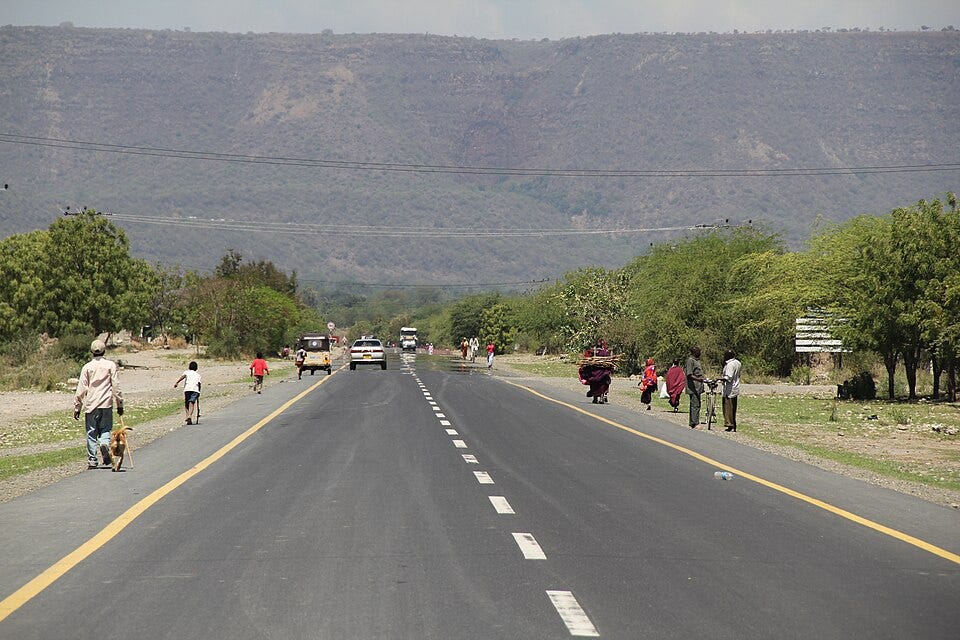
Photo: The Erica Chang, Highway in Tanzania.1
On the Tanzania to Zambia highway, local tuk-tuk drivers have a set price for their service. Often there is just one road to town and one price attached to a ride there. Drivers and transport operators know what people are willing to pay and the profits that they make is their family’s livelihood: food, housing, school fees, etc. The consequences of the US-Iran War mean that the margins for this type of service are significantly thinner than before.
In Mafinga, a small town on the Tanzam highway, fares have increased, so less people take rideshares, tuk-tuks and bodas (motorcycle taxis). Where there is no budget for transport to town, most people have no choice but to walk one to two hours each way to buy their weekly groceries at the local markets.
These are people that do not vote in American elections and have no stake in what happens in the Strait of Hormuz. Yet decisions between nations six thousand kilometres away have affected business across the region in harsh and unforgiving ways. This is the quiet mechanism of a globalized fuel market: it transmits the tremors of distant wars to the people least equipped to absorb them, without any warning.
The fuel shock
The war between Iran and the US–Israeli coalition broke out at the end of February 2026. Within days, the closure of the Strait of Hormuz, the narrow channel through which roughly a fifth of the world’s oil passes, became the largest disruption in the history of the global oil market.2 Brent crude oil, which had been trading around $70 a barrel, climbed toward $120 by late March, and still sits above $100 today.3
For a country like Tanzania, that means major economic shocks. Tanzania imports almost all of its fuel. Each month, the Energy and Water Utilities Regulatory Authority (EWURA) sets a cap on pump prices based on global oil prices, plus shipping and insurance costs.4
In March, petrol in Dar es Salaam was capped at 2,864 Tanzanian shillings per litre before its first increase. In April, it jumped to 3,820, an increase of 33%, with the price of diesel facing a similar jump.5 The consequences of attacks on Gulf oil infrastructure, the closure of the Strait, a shortage of cargo vessels, and higher insurance premiums for tankers have now all been passed down to the consumer.
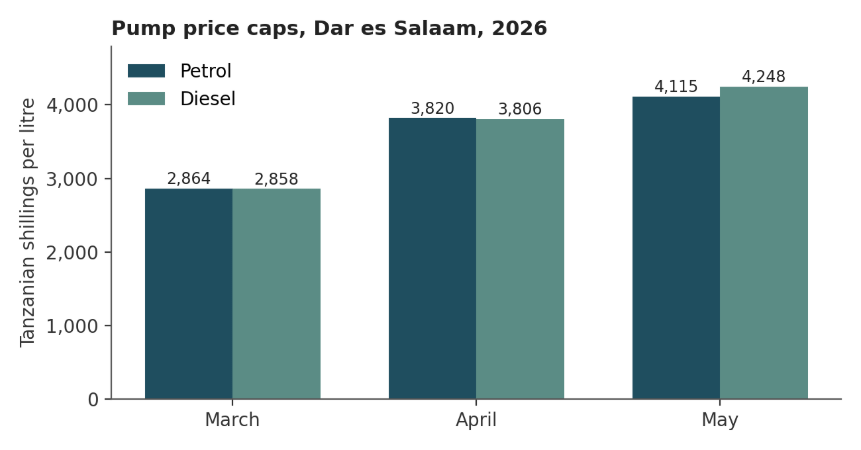
Figure 1: Fuel prices in Dar es Salaam Tanzania around the onset of the US-Iran War
The fertilizer shock
The Strait also carries about a third of the world’s seaborne fertiliser trade, and the natural gas disrupted by Gulf strikes is a raw material in the production of nitrogen fertilizer.6 An estimated 3.9 million tonnes of these imports have been suspended, which is equivalent to 30% of the annual fertilizer exports of the Gulf States.7
At the end of that chain, in East Africa, are smallholder farmers, who grow close to 70% of the region’s food.8 Unlike commercial farms, smallholders cannot buy a season’s inputs in advance so they are left with two options: pay the full price or use less fertilizer. Many are forced to choose the latter, which means weaker harvests and smaller incomes, while the prices they receive for their crops remain the same.
The impacts on the East African household
The effects of fuel shortages and fertilizer imports in Tanzania is still relatively manageable. In East Africa, where Tanzania is a growing industrial leader, its neighbouring countries are facing even more extreme shocks. Tanzania’s main port in Dar es Salaam receives international trade that serves the majority of East Africa. Countries like Zambia, the Democratic Republic of Congo, Rwanda, Burundi, and Malawi all depend on Tanzania for maritime access, receiving all types of essential goods, from petrol to vital medications. But goods are cheaper at the port. What this means is that more remote parts of Tanzania and its neighbours furthest from the coast, pay the steepest premium to move anything at all. Take a look at this figure for perspective on the sheer volumes moving through Dar’s port to neighbouring countries.9
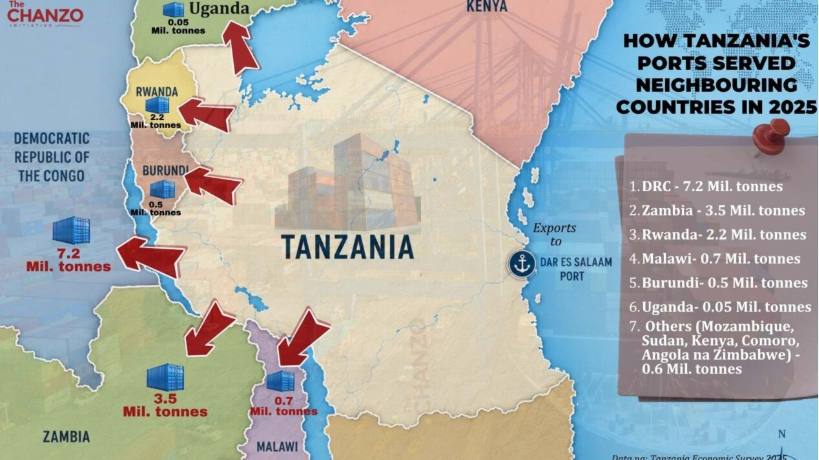
Figure 2: Share of goods moving through Dar’s port to neighbouring countries
Unfortunately, the fuel and fertilizer shocks that affect the rural Tanzanian, are only magnified for the Burundian or Zambian. In fact, for Burundi, a land-locked neighbour of Tanzania that has been facing extreme fuel shortages for the past five years is expected to see a 40% disruption in their export market due to the conflict in the Middle East.10 Estimates suggest that the conflict in the Middle East might eventually push 45 million people to acute hunger this year due to rising prices and food scarcity due to fertilizer shortages.11
Why the same shock affects people differently
In the high-income countries, a fuel spike is a nuisance that may cause some financial strain. For reference, households across the OECD spend, on average, around 12.7% of their expenditure on transport, with the great bulk of that being ownership of a car.12 The fuel itself is a smaller slice. In the United States, petrol and motor oil have long hovered around three to four per cent of the household budget.13 When that share increases, most families in Europe or America can absorb it. There is a buffer room.
In developing countries, there is no buffer. Crucial items like fuel contribute directly to how people earn and receive basic goods. The bajaji driver, the lorry operator hauling maize to the market, and the miller are actively struggling from the inability to budget for these raw materials that make up their livelihoods. A price rise negatively affects a disproportionate share of their income. And since nearly every good in the country moves by road, the same shock arrives again, disguised as the price of food, charcoal, or fertilizer for their farms.
On paper, Sub-Saharan African households spend around 9% of their budgets on transport, a figure that seems modest beside the OECD’s. But for low-income urban families the real share climbs to 15 or 20%, with 15% being the threshold above which researchers consider mobility simply unaffordable,14 pricing out the very poorest of groups from motorised transport altogether.15 Researchers have found that the reduction in the consumption of transport services is often greater than the reduction in living standards.16
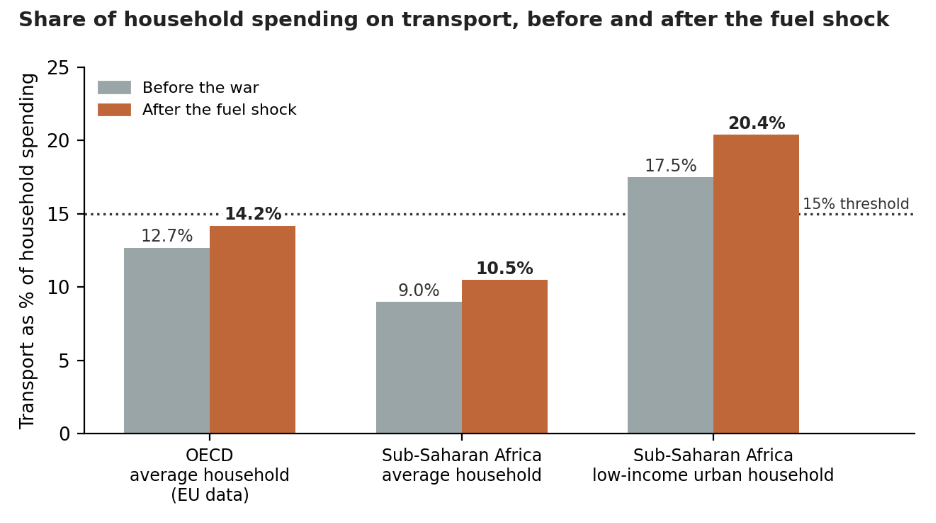
Figure 3: Transport as a share of household spending, before and after the fuel shock
These figures only count money spent. For many East Africans, walking is a solution for the high cost of transport. Each fare increase pushes more people onto their feet. These figures exclude households that walk to avoid fares, so they even understate the burden on the poorest. In Mafinga for example, instead of paying the extra thousand Tanzanian shillings it might cost them to move around during the day, people pay with time. It is not uncommon to hear someone say that they wake up an hour earlier to walk to work in time, arriving home at night an hour later. When the individual chooses to not pay monetarily, they pay with their precious time. And those extra hours come out of something: sleep, time with family, work on their family farm or a second job. For people already living on the margin, time is often the last thing they have to give.
That, in the end, is the story worth telling. The war has revealed a vulnerability for those who cannot control the architecture of globalized markets for vital goods. Countries will continue to dominate and transmit their shocks to economies that import their energy, move everything by road, and hold little to no reserve. The question this war leaves behind is what it will take for rural Tanzanians to stop paying for a war they have nothing to do with.
Bibliography
“African Governments Urged to Tackle Fertilizer Shortages.” Africa-Press, April 28, 2026. https://www.africa-press.net/tanzania/all-news/african-governments-urged-to-tackle-fertilizer-shortages.
“Brent Crude Oil.” Trading Economics. Accessed September 29, 2026. https://tradingeconomics.com/commodity/brent-crude-oil.
Diaz Olvera, Lourdes, Didier Plat, and Pascal Pochet. “Household Transport Expenditure in Sub-Saharan African Cities: Measurement and Analysis.” Journal of Transport Geography 16, no. 1 (2008): 1–13. https://www.sciencedirect.com/science/article/abs/pii/S0966692307000452.
“DRC Emerges as Largest Transit Cargo Market for Tanzania Ports.” The Chanzo, July 4, 2026. https://thechanzo.com/2026/07/04/drc-emerges-as-largest-transit-cargo-market-for-tanzania-ports.
Energy and Water Utilities Regulatory Authority (EWURA). Cap Prices for Petroleum Products, April 2026. Public notice. Dodoma: EWURA, April 1, 2026. https://www.ewura.go.tz/uploads/documents/en-1774990962-Cap%20Prices%20for%20April%202026%20-%20English%20(2).pdf.
“EU: Diesel Prices Hit an All-Time High of €2.23 per Litre.” Eunews, September 24, 2026. https://www.eunews.it/en/2026/09/24/fuel-prices-diesel-in-the-eu-hits-an-all-time-high-of-e2-23-per-litre/.
European Central Bank. “What Is Inflation?” Accessed September 29, 2026. https://www.ecb.europa.eu/ecb-and-you/explainers/tell-me-more/html/what_is_inflation.en.html.
Eurostat. “Household Consumption by Purpose.” Statistics Explained, November 21, 2025. https://ec.europa.eu/eurostat/statistics-explained/index.php?title=Household_consumption_by_purpose.
Famine Early Warning Systems Network (FEWS NET). Burundi Food Security Outlook Update: April 2026. FEWS NET, April 2026. https://fews.net/east-africa/burundi/food-security-outlook-update/april-2026.
“Fuel Prices Surge Further as Government Subsidises Diesel.” The Citizen (Dar es Salaam), May 6, 2026. https://www.thecitizen.co.tz/tanzania/news/national/fuel-prices-surge-further-as-government-subsidises-diesel-5449090.
Gandelman, Néstor, Tomás Serebrisky, and Ancor Suárez-Alemán. “Household Spending on Transport in Latin America and the Caribbean: A Dimension of Transport Affordability in the Region.” Journal of Transport Geography 79 (2019): 102482. https://www.researchgate.net/publication/334812690_Household_spending_on_transport_in_Latin_America_and_the_Caribbean_A_dimension_of_transport_affordability_in_the_region.
“How Much Americans Spend on Fuel.” True Driving Cost. Updated September 26, 2026. https://truedrivingcost.com/articles/how-much-americans-spend-on-fuel.
International Energy Agency. Oil Market Report – March 2026. Paris: IEA, March 2026. https://www.iea.org/reports/oil-market-report-march-2026.
“Iran War: From Fertilizer to Food Crisis?” IFPRI Blog. International Food Policy Research Institute, July 2, 2026. https://www.ifpri.org/blog/iran-war-from-fertilizer-to-food-crisis/.
“Iran War Inflates Price of Fossil Fuel-Based Fertilizer and Groceries.” Oil & Gas Watch, May 7, 2026. https://news.oilandgaswatch.org/post/iran-war-inflates-price-of-fossil-fuel-based-fertilizer-and-groceries.
SLOCAT Partnership. “Africa Regional Overview.” In Transport and Climate Change Global Status Report, 3rd ed. SLOCAT, 2023. https://tcc-gsr.com/module-2-2/africa-regional-overview/.
“Tanzania Fuel Prices Surge to Record Highs as US-Israeli War on Iran Bites.” The Citizen (Dar es Salaam), April 1, 2026. https://www.thecitizen.co.tz/tanzania/news/national/tanzania-fuel-prices-surge-to-record-highs-as-us-israeli-war-on-iran-bites-5409706.
“Transport Stakeholders Call for Review of Fuel Levies as Govt Increases Bus Fares.” The Citizen (Dar es Salaam), April 20, 2026. https://www.thecitizen.co.tz/tanzania/business/transport-stakeholders-call-for-review-of-fuel-levies-as-govt-increases-bus-fares-5429580.
World Food Programme. “WFP Warning Becomes a Reality for Millions as Middle East Crisis Pushes Poorest Families Further into Hunger.” News release, June 2026. https://www.wfp.org/news/wfp-warning-becomes-reality-millions-middle-east-crisis-pushes-poorest-families-further-hunger.
The Erica Chang. Highway in Tanzania. Photograph, December 4, 2011. Wikimedia Commons. https://commons.wikimedia.org/wiki/File:Highway_in_Tanzania_-_panoramio.jpg.

International Energy Agency, Oil Market Report – March 2026.
“Brent Crude Oil,” Trading Economics.
Energy and Water Utilities Regulatory Authority (EWURA), Cap Prices for Petroleum Products, April 2026.
“Tanzania Fuel Prices Surge to Record Highs,” The Citizen.
“Iran War Inflates Price of Fossil Fuel-Based Fertilizer,” Oil & Gas Watch.
“Iran War: From Fertilizer to Food Crisis?,” IFPRI Blog.
“African Governments Urged to Tackle Fertilizer Shortages,” Africa-Press.
“DRC Emerges as Largest Transit Cargo Market,” The Chanzo.
Famine Early Warning Systems Network, Burundi Food Security Outlook Update: April 2026.
World Food Programme, “WFP Warning Becomes a Reality.”
Eurostat, “Household Consumption by Purpose.”
“How Much Americans Spend on Fuel,” True Driving Cost.
Diaz Olvera, Plat, and Pochet, “Household Transport Expenditure.”
SLOCAT Partnership, “Africa Regional Overview.”
Diaz Olvera, Plat, and Pochet, “Household Transport Expenditure.”